
Again! Warsaw Administrative Court rules in favor of our Client: Administrative Court Suspends Another Negative Immigration Decision
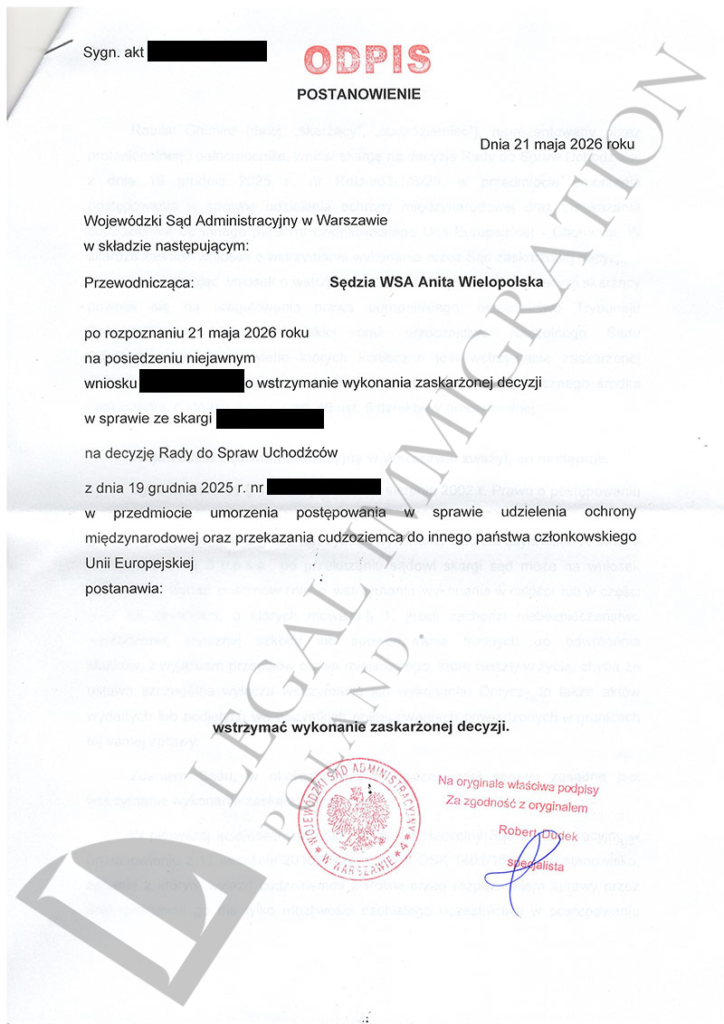
Receiving a negative immigration decision can feel like the ground is slipping from beneath your feet. Suddenly, your future in Poland, your job, and your family’s stability are thrown into limbo. However, a negative decision from an administrative organ is not the end of the road. Ruling of Administrative Court in Warsaw that Suspended Negative Refugee Decision Our legal team has secured another critical victory at the Warsaw Administrative Court (WSA). On May 21, 2026 Warsaw Administrative Courte judge Aleksandra Wielpolska issued a favorable ruling (postanowienie) completely suspending the execution of a negative decision issued by the Refugee Council (Rada do Spraw Uchodźców) to transfer our client to another EU State. Here is what this means for our clients, why it is an absolute game-changer, and how we apply this winning strategy across multiple areas of immigration law, including Temporary Residence Cards (TRC). The Power of a Suspension Ruling: What Just Happened? In this specific case, the Refugee Council had issued a decision to discontinue international protection proceedings and transfer our client to another EU Member State under the Dublin regulation. Normally, such a decision paves the way for an immediate, forced departure or transfer. Legal Immigration Poland legal team immediately stepped in, filing a comprehensive complaint along with a strategic motion to suspend the execution of the decision which lets our client (1) stay legally in Poland with (2) keep his right to work fully legally and (3) entertain the right to free medical health care as long as his case will be ongoing (probably for a next few years). The Court agreed with our argumentation, ruling to fully suspend the execution of the challenged decision. Why This Is Important for the Client Immediate Protection from Deportation/Transfer: The most crucial benefit is that the client cannot be forced to leave Poland or be transferred to another country while the main court case is pending. Preservation of Legal Status: It temporarily freezes the negative effects of the immigration ruling. The client remains legally on Polish territory. Elimination of “Irremediable Harm”: The law allows for a suspension if executing the decision risks causing severe damage or irreversible consequences. By winning this motion, we buy our clients the time they need to fight their case without the looming threat of sudden removal. Beyond Refugee Cases: Winning Suspensions for temporary residence permit in Poland/TRCin Poland (Karta Pobytu) Decisions Our success in freezing negative immigration outcomes is not limited to international protection in Poland. We regularly deploy high-stakes legal strategy to safeguard clients who have received negative Temporary Residence Card (TRC) decisions from the Chief of Foreigners Office (Szef Urzędu do Spraw Cudzoziemców) and want to avoid deportation at any cost. For instance, in a court case against decision of Chief for Foreigners Office (Szef Urzędu do Spraw Cudzoziemców) denying temporary residence permit due to providing falsified bank statements by client’s previous representative (non-professional lawyer, so called “agent”) the Warsaw Administrative Court by the ruling of 8th August 2024 decided to suspend negative temporary residence permit decision (TRC) for the time of entire court procedure, which can sometimes last even a few years. Of course during that time a client is allowed to stay legally in Poland and under certain circumstances also work legally. The most important, however, is a priceless peace of mind with no risk of arrest and deportation. What are the Implications of a TRC in Poland Suspension? When a final administrative decision denies a TRC, the law typically requires the foreigner to leave Poland within 30 days. Filing a standard complaint to the WSA does not automatically pause this clock. That is where our specialized litigation tactics make the difference. When we successfully obtain a suspension ruling for a negative TRC decision, the implications are profoundly beneficial: No Requirement to Leave: The 30-day deadline to exit the country is completely paused. Continuous Legal Stay: Your right to remain in Poland is securely locked in place until the Warsaw Administrative Court and the Supreme Administrative Court fully review the your case, which may take a few years; Business and Life Continuity: It provides immense psychological relief and practical stability. You can continue living your life, maintaining your home, and awaiting a fair trial without the constant anxiety of an unexpected border guard inspection. Trust, Experience, Professionalism. Act Swiftly. Immigration litigation requires precision, deep familiarity with administrative court trends, and rapid action. A motion for suspension must be flawlessly argued, proving to the judge exactly why an immediate execution of the decision would cause severe and irreversible harm. As this latest May 2026 ruling proves, our tailored approach works. We do not just file paperwork—we build shields that protect your life and future in Poland. Why Investing in a Licensed Immigration Advocate is Your Only Real Shield in Poland When your future in Poland is on the line, cutting corners with unlicensed “agents” or cheap document-filling services (also Russian called “pomagatory”) is the fastest way to get into immigration trouble finally ending up with a deportation order. Immigration litigation before the Immigration procedures in Poland are highly complex and formalistic. Administrative Court representation requires a deep understanding of evolving case law and precise legal argumentation. A licensed advocate (“adwokat”) or legal advisor (“radca prawny”) is bound by strict professional ethics, carries malpractice insurance, and possesses the exclusive right to represent you directly before a judge. Safeguarding professional TRC representation, crafting a successful motion for suspension TRC decision is not a matter of filling out templates from Internet or Chat GPT; it requires flawless legal analysis to prove legal premises to a judge. This is why professional legal representation provided by Legal Immigration Poland is an investment in your future life in Poland – not a mass cheap service based on Internet templates, that most probably will lead you to destroying your immigration opportunities in Poland and deportation with EU/Schengen ban for years. Received a negative decision? Do not wait for the clock to run out. The window to appeal
Success of Our Law Firm in a Court Case Before the Provincial Administrative Court in Warsaw

We’re thrilled to share a remarkable victory achieved by our law firm, a success that could become yours too! We recently represented a foreign client before the Provincial Administrative Court in Warsaw, challenging a decision of the Head of the Office for Foreigners (Szef Urzędu do Spraw Cudzoziemców). The decision of Wojewoda Mazowiecki (I instance immigration authority) and the second decision of the Head For Foreigners Office (II instance immigration authority) denied a temporary residence permit in Poland. As a result of court appeal filed by our immigration advocate Patryk Przeździecki, the court overturned the negative decision and awarded procedural costs for our client. The client is again legal to stay in Poland with a right to work. This outcome highlights how crucial it is to have the right legal support by your side. Why Was the Residence Permit Denied? Our client, a foreign national, applied for a temporary residence permit in Poland to continue full-time studies. Being new to Poland and unfamiliar with legal matters, especially in a foreign country, the client sought assistance from an agency specializing in legalizing foreigners’ stay—just as many of his fellow students had done. Unfortunately, this decision led to serious complications. During the proceedings, the Voivode questioned the authenticity of a bank statement submitted to the Immigration Office in his TRC in Poland case. The Border Guard, in its preparatory investigation, determined that the statement, along with other documents related to foreigners’ bank accounts in the same bank, was not authentic. Thus, the Voivode concluded that the document had been created solely for the purpose of the proceedings and deemed the client’s presence in Poland a potential threat to public security. This decision was upheld by the Head of the Office for Foreigners, even though the client submitted an updated and valid bank statement and independently appealed the Voivode’s decision without help of previous representative. Although, the documents filed with Wojewoda Mazowiecki by the client’s former agent proved to be falsified (not-authentic), we were able to obtain a favourable court verdict for our client. The Crucial Role of Our Attorney When our client found himself in a challenging situation, he contacted our law office. This decision changed everything! Thanks to a thorough analysis of the case, clear explanation of risks and opportunities, and a professional legal strategy, we were able to file a successful appeal with the Provincial Administrative Court in Warsaw. The court sided with our arguments, overturned the contested decision, and ordered a reexamination of our client’s case. What Did Our Client Gain with Our Help? Legal residence and work rights in Poland – the client can now continue his professional career. The ability to continue education A stable future in Poland – completing his education opens the door to a dream career and stability, fulfilling his family’s aspirations. Proof of no threat to public security – the client demonstrated his is a trustworthy individual, allowing him freedom of movement within EU countries. Compensation for the inability to work – the client may seek approximately 25 000 PLN in compensation from the State Treasury for the six months when their stay was considered illegal. A Lesson About Non-Licensed Representation As we mentioned, in the first instance, our client entrusted his TRC in Poland case to a non-licensed representative. Unfortunately, this turned out to be a significant mistake. The client was not kept informed about the case’s progress, and his interests were not adequately protected. Why Is the Choice of Legal Representative So Important? Our client’s case is a clear example of how crucial it is to choose the right legal representative from the very beginning of immigration process. Entrusting your case to non-licensed agents who lack the necessary qualifications can lead to serious issues, wasted time, financial losses, and even the forfeiture of opportunities for a favorable resolution and a secure future. Why Invest in Professional Legal Assistance? Turn Your Challenges into Opportunities! This success story demonstrates the importance of experienced legal support in complex administrative cases. Thanks to our attorney’s efforts, the client achieved justice and gained a chance to pursue his plans and dreams. Investing in a reputable lawyer is often the best decision you can make in difficult legal situations. If you find yourself in a similar position, do not hesitate to contact us—we are here to help! Kind regards, “Legal Immigration Poland” Immigration Department of “Kancelaria Adwokacka Adwokat Patryk Przeździecki” Your legal safety is in the best hands.
Success Story: Securing a 3-Year Work TRC in Poland Despite Criminal Record
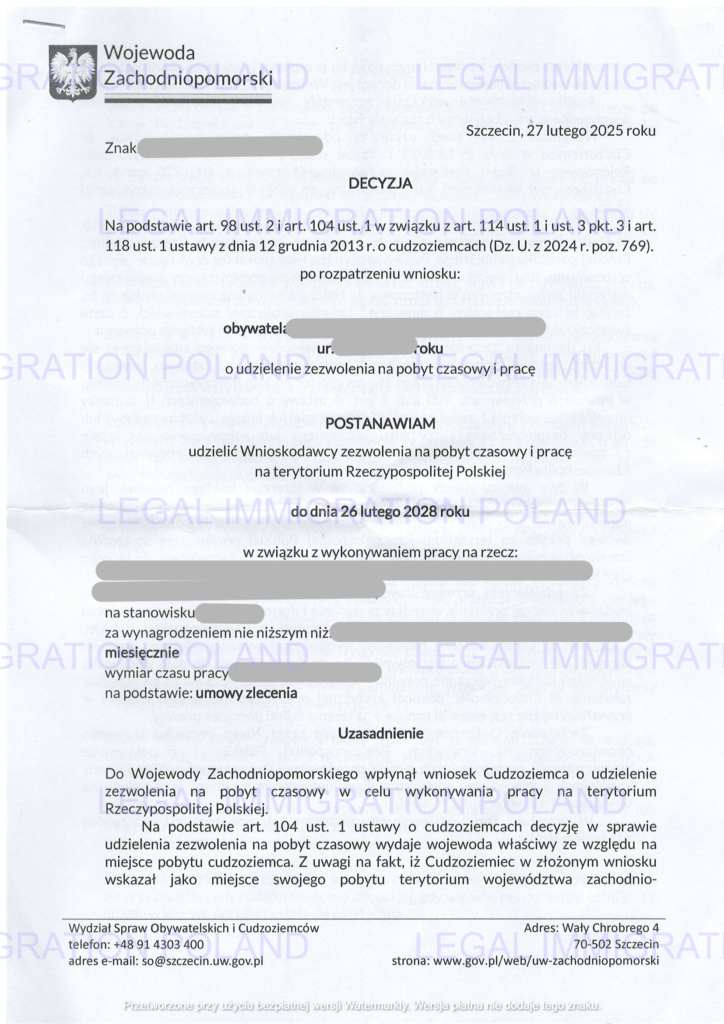
At Legal Immigration Poland, we specialize in assisting foreigners with immigration matters, even in the most challenging situations. One of our recent successes involved helping a client who had a criminal record in Poland obtain a 3-year temporary residence permit in Poland based on work. Given the strict current immigration policies in Poland regarding individuals with a criminal history, this was a remarkable achievement. The Challenge: Criminal Record in Poland and High Risk of Rejection Our client had a criminal record in Poland, what causes high risk of reqection on TRC in Poland applications since polish immigration law remains very strict when assessing applicants with a criminal record. Under current regulations, a criminal record in Poland can be a ground for denial of a residence permit or even deportation, as authorities assess whether an individual poses a threat to public security. With Poland tightening its immigration policies for 2025–2030, the risk of rejection for applicants with a criminal past has increased even further. Our Strategy: Proving That Our Client Deserved to Stay Knowing the complexity of this case, our immigration specialist took a strategic approach to demonstrate that our client posed no risk and deserved the opportunity to continue living and working in Poland. Our actions included: Comprehensive Legal Argumentation: We have carefully reviewed the details of the criminal case in Poland and prepared a detailed explanation of our client’s situation, emphasizing his rehabilitation and law-abiding behavior since the conclusion of the case. Engaging with Authorities: We proactively communicated with the Immigration Office in Szczecin, providing legal justifications and responding to any concerns raised during the review process. Additional Administrative Review: Due to the criminal record in Poland, the immigration office initiated a special additional administrative assessment to evaluate any risks. We assisted in providing: A full explanation of the case outcome. Documentation proving that the client had fulfilled all legal obligations related to the case. Evidence that they were now a responsible, law-abiding resident of Poland. Direct Negotiations: Our specialist had direct discussions with immigration officers, addressing any uncertainties and reinforcing our client’s eligibility for a residence permit. The Outcome: A 3-Year Work TRC in Poland Approved Despite the high risk of rejection, our legal expertise and well-prepared case convinced the West Pomeranian Voivode to grant our client a temporary residence permit in Poland based on work for the maximum period of 3 years. Please see below the decision of the Voivode. What This Case Teaches Us This success story highlights the importance of professional legal support when dealing with immigration matters involving a past criminal record. Key takeaways include: A completed criminal case can still affect immigration applications, but it does not automatically mean rejection. Each case is unique—proper legal representation can help prove rehabilitation and compliance with the law. Poland’s immigration laws are becoming stricter, making it even more critical to seek expert assistance in such situations. If you or someone you know is facing challenges obtaining a residence permit in Poland due to a past legal issue, our firm is here to help. What is more, if you have an ongoing criminal case in Poland our polish licensed attorney Patryk Przeździecki will be happy to help you with the whole process! Contact us today for an introductory legal consultation!
Apostille and Legalization of Foreign Documents in Poland in 2025 — Don’t Be Misled by False Information

Recently, a wave of misinformation has been spreading online claiming that on May 12, 2025 the President of Poland signed amendments to the legislation, according to which foreign state documents (such as birth certificates, marriage certificates, name change certificates, etc.) will be accepted by Polish authorities only if they have an apostille or legalization. As a professional immigration law firm in Poland, we would like to clarify that this information is false and misleading. The Truth Behind the Headlines The President of Poland has NOT signed any legal amendments introducing such a requirement. No such law has come into force, nor are there any officially published legislative proposals currently under review. The rules regarding recognition of foreign official documents in Poland have not changed. What Rules Apply Now? The recognition of foreign official documents in Poland has always been regulated by bilateral agreements signed between Poland and certain countries. This means: If your country has a bilateral agreement with Poland regarding mutual recognition of documents — no apostille or legalization is required. If there is no such agreement — your document must be either legalized or have an apostille to be accepted by Polish authorities. Why This Matters Following misleading or unofficial information can result in: Wasted time and money on unnecessary legalization/apostille, Unjustified stress or panic. What Should You Do? If you’re applying for TRC in Poland, PRC in Poland, Polish citizenship, marriage, or you’re in the process of any other administrative procedures in Poland: Do not trust rumors or unofficial sources. Consult with a qualified legal advisor. Check if your country has an agreement with Poland. Our Support Our experienced team of lawyers and immigration specialists provides consultations to foreigners on issues of document recognition, legalization and registration of stay in Poland. Sign up for a legal consultation to: check the requirements for your documents, avoid negative decisions in administrative proceedings, get professional legal assistance. Book your legal consultation today! Be careful. Trust only verified sources and professional lawyers.
Success Story: Securing a 3-Year Work TRC in Poland Despite Criminal Record
At Legal Immigration Poland, we specialize in assisting foreigners with immigration matters, even in the most challenging situations. One of our recent successes involved helping a client who had a criminal record in Poland obtain a 3-year temporary residence work permit in Poland based on work. Given the strict current immigration policies in Poland regarding individuals with a criminal history, this was a remarkable achievement. The Challenge: Criminal Record in Poland and High Risk of Rejection Our client had a criminal record in Poland, what causes high risk of reqection on TRC in Poland applications since polish immigration law remains very strict when assessing applicants with a criminal record. Under current regulations, a criminal record in Poland can be a ground for denial of a residence permit or even deportation, as authorities assess whether an individual poses a threat to public security. With Poland tightening its immigration policies for 2025–2030, the risk of rejection for applicants with a criminal past has increased even further. Our Strategy: Proving That Our Client Deserved to Stay Knowing the complexity of this case, our immigration specialist took a strategic approach to demonstrate that our client posed no risk and deserved the opportunity to continue living and working in Poland. Our actions included: Comprehensive Legal Argumentation: We have carefully reviewed the details of the criminal case in Poland and prepared a detailed explanation of our client’s situation, emphasizing his rehabilitation and law-abiding behavior since the conclusion of the case. Engaging with Authorities: We proactively communicated with the Immigration Office in Szczecin, providing legal justifications and responding to any concerns raised during the review process. Additional Administrative Review: Due to the criminal record in Poland, the immigration office initiated a special additional administrative assessment to evaluate any risks. We assisted in providing: A full explanation of the case outcome. Documentation proving that the client had fulfilled all legal obligations related to the case. Evidence that they were now a responsible, law-abiding resident of Poland. Direct Negotiations: Our specialist had direct discussions with immigration officers, addressing any uncertainties and reinforcing our client’s eligibility for a residence permit. The Outcome: A 3-Year Work TRC in Poland Approved Despite the high risk of rejection, our legal expertise and well-prepared case convinced the West Pomeranian Voivode to grant our client a temporary residence permit in Poland based on work for the maximum period of 3 years. Please see below the decision of the Voivode. What This Case Teaches Us This success story highlights the importance of professional legal support when dealing with immigration matters involving a past criminal record. Key takeaways include: A completed criminal case can still affect immigration applications, but it does not automatically mean rejection. Each case is unique—proper legal representation can help prove rehabilitation and compliance with the law. Poland’s immigration laws are becoming stricter, making it even more critical to seek expert assistance in such situations. If you or someone you know is facing challenges obtaining a residence permit in Poland due to a past legal issue, our firm is here to help. What is more, if you have an ongoing criminal case in Poland our polish licensed attorney Patryk Przeździecki will be happy to help you with the whole process! Contact us today for an introductory legal consultation!
Success of Our Law Firm in a Court Case Before the Provincial Administrative Court in Warsaw
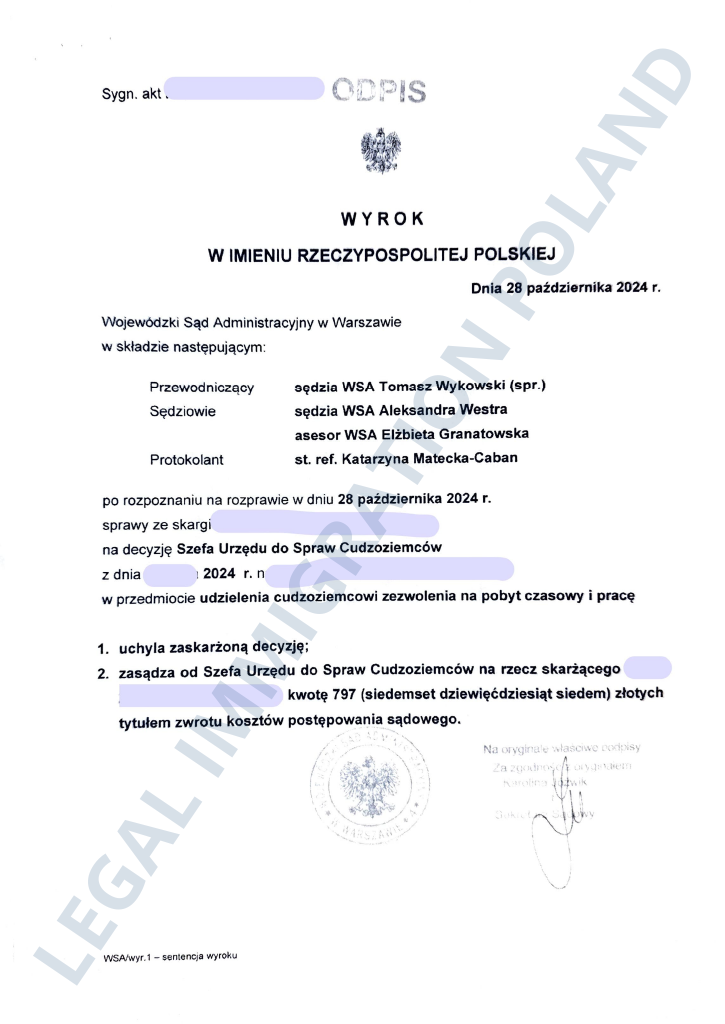
We’re thrilled to share a remarkable victory achieved by our law firm, a success that could become yours too! We recently represented a foreign client before the Provincial Administrative Court in Warsaw, challenging a decision of the Head of the Office for Foreigners (Szef Urzędu do Spraw Cudzoziemców). The decision of Wojewoda Mazowiecki (I instance immigration authority) and the second decision of the Head For Foreigners Office (II instance immigration authority) denied a temporary residence permit in Poland. As a result of court appeal filed by our immigration advocate Patryk Przeździecki, the court overturned the negative decision and awarded procedural costs for our client. The client is again legal to stay in Poland with a right to work. This outcome highlights how crucial it is to have the right legal support by your side. Why Was the Residence Permit Denied? Our client, a foreign national, applied for a temporary residence permit in Poland to continue full-time studies. Being new to Poland and unfamiliar with legal matters, especially in a foreign country, the client sought assistance from an agency specializing in legalizing foreigners’ stay—just as many of his fellow students had done. Unfortunately, this decision led to serious complications. During the proceedings, the Voivode questioned the authenticity of a bank statement submitted to the Immigration Office in his TRC in Poland case. The Border Guard, in its preparatory investigation, determined that the statement, along with other documents related to foreigners’ bank accounts in the same bank, was not authentic. Thus, the Voivode concluded that the document had been created solely for the purpose of the proceedings and deemed the client’s presence in Poland a potential threat to public security. This decision was upheld by the Head of the Office for Foreigners, even though the client submitted an updated and valid bank statement and independently appealed the Voivode’s decision without help of previous representative. Although, the documents filed with Wojewoda Mazowiecki by the client’s former agent proved to be falsified (not-authentic), we were able to obtain a favourable court verdict for our client. The Crucial Role of Our Attorney When our client found himself in a challenging situation, he contacted our law office. This decision changed everything! Thanks to a thorough analysis of the case, clear explanation of risks and opportunities, and a professional legal strategy, we were able to file a successful appeal with the Provincial Administrative Court in Warsaw. The court sided with our arguments, overturned the contested decision, and ordered a reexamination of our client’s case. What Did Our Client Gain with Our Help? Legal residence and work rights in Poland – the client can now continue his professional career. The ability to continue education A stable future in Poland – completing his education opens the door to a dream career and stability, fulfilling his family’s aspirations. Proof of no threat to public security – the client demonstrated his is a trustworthy individual, allowing him freedom of movement within EU countries. Compensation for the inability to work – the client may seek approximately 25 000 PLN in compensation from the State Treasury for the six months when their stay was considered illegal. A Lesson About Non-Licensed Representation As we mentioned, in the first instance, our client entrusted his TRC in Poland case to a non-licensed representative. Unfortunately, this turned out to be a significant mistake. The client was not kept informed about the case’s progress, and his interests were not adequately protected. Why Is the Choice of Legal Representative So Important? Our client’s case is a clear example of how crucial it is to choose the right legal representative from the very beginning of immigration process. Entrusting your case to non-licensed agents who lack the necessary qualifications can lead to serious issues, wasted time, financial losses, and even the forfeiture of opportunities for a favorable resolution and a secure future. Why Invest in Professional Legal Assistance? Turn Your Challenges into Opportunities! This success story demonstrates the importance of experienced legal support in complex administrative cases. Thanks to our attorney’s efforts, the client achieved justice and gained a chance to pursue his plans and dreams. Investing in a reputable lawyer is often the best decision you can make in difficult legal situations. If you find yourself in a similar position, do not hesitate to contact us—we are here to help! Kind regards, “Legal Immigration Poland” Immigration Department of “Kancelaria Adwokacka Adwokat Patryk Przeździecki” Your legal safety is in the best hands.
Disciplinary Proceedings for Students in Polish Universities: Consequences of Using Fraudulent Documents

For international students, studying in Poland presents incredible opportunities for education and career development. However, these opportunities come with serious responsibilities, including compliance with the law during the process of obtaining or renewing residence permits. Unfortunately, some students due to poor advice or fraudulent practices by their agents face harsh penalties, including not only negative decisions on their TRC in Poland cases and Request to leave the territory of Poland, but also disciplinary proceedings by their universities. This article explores what disciplinary proceedings are, how they can be triggered by the use of fraudulent documents, and the severe consequences students can face, including expulsion from their university. How Fraudulent Documents Lead to Disciplinary Proceedings In Poland, international students applying for temporary residence permits must provide documentation to prove they meet the legal requirements for staying in the country. One of the common documents is a bank certificate that proves financial stability during their studies. However, the last 6 months have showed that some students, knowingly or unknowingly, submit false or fraudulent documents through their legal representatives or agents. When the Polish immigration office detects a fraudulent document in a student’s residence permit application, they immediately issue negative decision on TRC in Poland case, request to leave the territory of Poland within 30 days and notify the rector of the student’s university. The rector is then obligated to initiate disciplinary proceedings against the student, as the use of fraudulent documents violates both legal and academic regulations. What Are Disciplinary Proceedings? Disciplinary proceedings are formal processes conducted by a university when a student is accused of breaking academic or legal rules. In the context of fraudulent documents, this process is initiated to determine whether the student deliberately violated the law or whether they were a victim of dishonest practices by legal representatives or agents. The Process of Disciplinary Proceedings Notification – The rector of the university receives information from the immigration office about the student’s submission of fraudulent documents. Investigation – The university’s disciplinary committee conducts an investigation to understand the circumstances surrounding the submission of the fraudulent document. This may include interviewing the student, reviewing documents, and gathering additional evidence. Student’s Defense – The student will be called to attend a disciplinary hearing where they can present their defense. They may explain whether they were aware of the fraud or if the document was submitted without their knowledge by a third party, such as a legal agent. Committee Decision – After reviewing all the evidence and hearing the student’s side, the disciplinary committee will decide on the outcome. The decision is based on the severity of the violation and the student’s level of involvement. Consequences of Disciplinary Proceedings The consequences of disciplinary proceedings vary depending on the case, but the penalties for using fraudulent documents can be severe, including: Expulsion from the University – The most severe outcome is expulsion, which results in the immediate termination of the student’s enrollment. This means the student will lose their place at the university and, as a result, their legal right to stay in Poland. Suspension or Fines – In some cases, students may face temporary suspension from their studies or be fined for their misconduct. However, these lighter penalties are rare when it comes to cases of document fraud. Impact on Immigration Status – In addition to disciplinary actions from the university, students found guilty of submitting fraudulent documents may face significant immigration consequences. Their residence permit application are denied, requests to leave the territory of Poland within 30 days are issued, and they may be banned from applying for a visa or residence permit in the future, not only in Poland but also within the wider Schengen Area. Importance of Choosing Licensed and Trustworthy Representatives One of the key issues in many of these cases is that students are often unaware that fraudulent documents have been submitted on their behalf. They may have trusted legal agents or representatives to handle their applications, only to discover that false documents were submitted without their knowledge. To avoid these risks, it is essential for students to: Choose licensed and reputable representatives – Before entrusting your application to any legal representative or agent, ensure that they are properly licensed to provide immigration services in Poland. Licensed professionals are held to high ethical standards and are less likely to engage in fraudulent practices. Stay involved in the process – Even if you hire a representative, stay informed and involved in the process. Ask to see the documents that are being submitted on your behalf, and ensure you understand all aspects of your application. Verify all information – Double-check the authenticity of any documents that are being submitted, particularly financial records like bank certificates. False documents, whether submitted intentionally or unknowingly, can have long-lasting effects. By taking responsibility for your own application, choosing trustworthy legal representatives, and ensuring that all submitted documents are legitimate, you can protect yourself from the risk of disciplinary actions and safeguard your academic and personal future in Poland.
Common Issues with Bank Statements for Students Applying for a Student TRC in Poland

If you’re a foreign student applying for a Student Temporary Residence Card in Poland, you may have noticed that the Immigration Office in Warsaw has recently increased its focus on reviewing financial documents, especially bank statements. This careful examination is meant to ensure that students can support themselves during their stay in Poland, which is a key requirement for obtaining the TRC. Increased Attention to Bank Statements Historically, issues with bank statements were a common reason for a Student TRC application rejections, often due to miscalculations of the required financial support that students need to demonstrate. However, more recently, the Immigration Office has started to look at bank statements more thoroughly, taking into account not just the amount of money in the account but also the consistency and reliability of the financial information provided. Requests for Additional Financial Documentation In many cases, around two months after submitting the TRC in Poland application, students receive a request from the Immigration Office to provide additional documentation. This may include: A current bank statement from your Polish bank account, showing recent amount of money you have. A bank statement covering the last 6 months, also from a Polish bank. These requests are aimed at verifying that students consistently maintain enough funds to cover their living expenses and tuition costs in Poland. This extra step helps ensure that the financial documentation is reliable and that students can comfortably meet the requirements. Common Challenges Faced by Students While the process is designed to ensure transparency, some students may experience challenges when submitting their bank statements. Here are a few common reasons for issues with TRC applications: Inconsistent Funds: It’s important to show that your account has a steady balance over time. Sudden large deposits, unexplained transactions, or irregular patterns in your account history can raise questions about your financial situation. Lack of Polish Bank Account: While having a foreign bank account may be acceptable, the Immigration Office typically prefers to see funds held in a Polish bank account. This helps demonstrate that you’re financially settled in Poland. Insufficient Funds: Even if your calculations were correct, you still need to ensure that your balance consistently reflects the required amount to cover your living and academic expenses. Falling below this threshold can result in complications with your TRC application. What Has Changed? While issues with bank statements have always been a concern for TRC applications, the recent increase in the thoroughness of the review means that students need to pay closer attention to both the amount of money in their accounts and how they present their financial history. In the past, rejections were primarily due to miscalculations of the necessary financial resources. Now, additional factors such as the consistency and transparency of the bank statements are being considered as well. How to Avoid Common Pitfalls To improve your chances of success with your Student TRC in Poland application, consider the following tips: Maintain a Consistent Balance: Make sure your account shows a steady balance over the required period. Try to avoid sudden large deposits that could appear irregular. Use a Polish Bank Account Use hard copy of bank statement: Visit one of the branches of your Polish Bank and get bank statement with wet stamp and signature of the relevant bank employe Remember that no one except you personally can obtain a statement of your bank account. What to Do If You Receive a Request If you receive a request from the Immigration Office for additional financial documents, don’t be alarmed. These requests are part of the routine process to ensure that applicants meet the financial requirements. Responding promptly and providing the requested documents will help keep your application on track. If you’re unsure about how to proceed, it’s a good idea to consult with our licensed immigration attorney or our immigration specialists. Conclusion While the Immigration Office in Warsaw has become more thorough in reviewing bank statements, students who carefully manage their finances and provide clear, consistent information should have no difficulty meeting the requirements. Being proactive and transparent with your financial documentation can help avoid delays or complications in your TRC application process. If you need help navigating Your student TRC in Poland application process, our team is here to assist. Contact us for a consultation and let us guide you through a successful application process.
Student Legalization Made Simple: Your Complete Guide to Legalization of your Long-Term Stay in Poland as a Student

Studying in Poland offers an enriching academic experience and opens doors to a world of opportunities for international students. As you start this exciting new chapter in your life, it’s crucial to understand the legal aspects of student legalization for a long-term stay at the territory of Poland. That’s why, we would like to help you in your student immigration to Poland journey and explain the process of legalization of your long-term stay in Poland, namely the process of obtaining student national visas and students residence permits, also provide you with essential information to make sure your immigration to Poland as a student goes smoothly and successfully. STEP 1 OF STUDENT IMMIGRATION TO POLAND: STUDENT NATIONAL TYPE „D” VISA TO POLAND The first step of student immigration to Poland, regarding the legalization of your stay, is to obtain a Type D National Visa from the Polish consulate or embassy in your home country. This visa allows you to enter Poland for a period exceeding 90 days and initiate the process of obtaining a residence permit for your studies. For students planning to study in Poland for a period exceeding 90 days, a Type D National Visa is required. This visa allows students to enter the country for up to 1 year and begin the process of obtaining a student temporary residence permit for the duration of their studies. Student National Visa to Poland Application Process: To apply for the Student Type „D” National Visa to Poland, students must visit the Polish consulate or embassy in their home country. The application requires a completed visa form, a valid passport, a letter of acceptance from a Polish educational institution, proof of sufficient funds to cover living expenses, health insurance coverage, flight itinerary and some more documents depending on your individual situation. Student National Visa to Poland Duration: The student type „D” national visa is usually granted for the duration of the academic year, allowing students ample time to complete their studies without interruptions. However, sometimes it can be issued for a shorter period of time depending on the request of student and program of studies. STEP 2 OF STUDENT IMMIGRATION TO POLAND: STUDENT TEMPORARY RESIDENCE PERMIT IN POLAND After arriving to Poland with a student type „D” national polish visa, students have the opportunity to apply for a Temporary Residence Permit in Poland for Studies. This permit allows students to legally reside in Poland for the period up to 3 years. duration of their academic program. Student TRC in Poland Application Process: To obtain the Temporary Residence Permit, students must submit an application to the appropriate Immigration Office in Poland depending on the place of you residence. There are several ways of application for TRC in Poland. For example, you can submit your documents personally at the Immigration Office or send your documents by registered mail “Poczta Polska”. The application should include an application form, 4 photos, copies of valid passport, proof of enrollment at a recognized educational institution, health insurance, proof of sufficient fund statement confirming accommodation arrangements and etc. Student TRC in Poland Duration: According to the Polish law on Foreigners, the 1st student TRC in Poland at the 1st year of studies should be granted for 15 months. The 2ndstudent TRC in Poland can be granted for the duration of your study program but not for more than 3 years. Student TRC in Poland Renewal and Extensions: The Temporary Residence Permit can be renewed or extended if the student’s academic program exceeds the initial duration. Students must apply for renewal before the last day of the current permit’s expiration. Navigating the student legalization process for long-term stay in Poland is a crucial step in ensuring a successful and fulfilling academic journey. Understanding the requirements and application procedures for a student national visas and residence permits is vital to avoid potential legal issues during your stay. Consulting with a reputable immigration specialists can offer valuable guidance and support throughout the entire process, helping you focus on your studies and make the most of your time as a student in Poland. Remember, each case may have its unique requirements, so seeking professional advice is the key to a smooth and stress-free experience as an international student in this beautiful and culturally diverse nation. Calling all students dreaming of studying in Poland! Get the right guidance and support you need to obtain your student visas and residence permits hassle-free. Purchase our expert legal consultation and immigration assistance services today, and let us help you make your dreams of studying in Poland come true!
Protect Your Future and Dreams: Beware of Student TRC SCAMS in Poland

Poland has become an increasingly popular destination for international students, offering a rich cultural experience and high-quality education in Europe. Unfortunately, with the rise in foreign student enrollment, there has also been a surge in immigration scams targeting foreign students. Unlicensed law firms are taking advantage of students’ eagerness to secure Temporary Residence Cards (TRCs) and other necessary documentation, leading to devastating consequences for the victims and their families. It’s crucial to recognize these fraudulent schemes to safeguard your education and future. In this article, we’ll explore how these scams operate and provide tips to avoid falling into their traps. Plan of the article The Nature of the Student TRC in Poland SCAM These fraudulent schemes often begin with seemingly legitimate offers of legal assistance to obtain student TRC in Poland. Unlicensed law firms, masquerading as reputable legal service providers, promise to handle all the necessary paperwork and legal procedures. However, these firms frequently submit fake documents and provide counterfeit legal services, putting students in a dangerous position. Many students discover these scams through recommendations from seemingly trustworthy sources, such as student organizations at their universities. With these endorsements, students believe they are in safe hands and proceed with the services offered. Sadly, their trust is misplaced. To make matters worse, these scammers often do not keep their clients informed about the status of their cases. They do not answer calls or provide updates, leaving students in the dark about their applications. When their applications for student TRC in Poland are unsuccessful and negative decisions by the Immigration Office are issued, these fraudulent firms often appeal these decisions without informing their clients, what does not allow students to take care about filing an effective appeal, about changing the current situation in which they unfortunately found themselves, about their awareness of what is happening. The appeal letters they submit are of such poor quality that achieving a positive outcome becomes nearly impossible. The Consequences The consequences of becoming a victim of such immigration fraud are serious and far-reaching. Innocent students, who have worked diligently to pursue their studies in Poland, are facing serious problems with polish law. The submission of falsified documents can lead to their deportation from Poland, ban from entering the EU, ruining their academic records and future career prospects. In some cases, students may even face imprisonment for document falsification, a criminal charge that can have long-lasting effects on their lives. Moreover, the impact extends beyond the students themselves. Families who have invested significant resources in the education and future of their children are left distraught, both emotionally and financially. The dream of studying in Poland turns into a nightmare, with aspirations shattered and lives turned upside down. Prevention: Protect Yourself To protect your future and avoid becoming a victim of student TRC in Poland scams, it is essential to take proactive steps: Verify Credentials and License: Always check the license and credentials of any law firm or legal service provider you intend to use. Ensure they are officially recognized and authorized to practice immigration law in Poland. You can check the license of any attorney or lawyer in Poland, including our attorney (Patryk Przeździecki with license WAW/Adw/5098), in the governmental databases online. Here is the link: https://rejestradwokatow.pl/adwokat https://rejestrradcow.pl/Home/Index Seek Recommendations Wisely: While student organizations and university contacts can be valuable resources, do not rely solely on their recommendations. Conduct your own research and due diligence. Consult Official Sources: Refer to official government websites and resources for information on legitimate legal services and procedures for obtaining TRCs and other documents. Be Cautious of Guarantees: Be careful of any firm that guarantees success or promises unusually quick results. Immigration processes can be complex and time-consuming, and no legitimate firm can assure outcomes. Demand Transparency: Ensure that the law firm provides regular updates on your case. Legitimate firms will maintain open lines of communication and keep you informed about every step of the process, including any decisions made on your applications. Our Commitment to Helping Students At our law firm, we understand the unique challenges faced by international students in Poland. To make our services more accessible for foreign students we offer reduced prices to help them legalize their stays in Poland. Conclusion Navigating the immigration process can be challenging, but by staying informed and cautious, you can protect yourself from fraudulent schemes. Remember, your dreams and future are worth safeguarding. Always verify the legitimacy of the legal services you engage, and do not hesitate to seek help from trusted and accredited sources. By taking these precautions, you can ensure that your journey to studying in Poland remains a positive and fulfilling experience. If you need assistance or have any questions about the immigration process, do not hesitate to contact our law firm. We are dedicated to providing legitimate and reliable legal services to help you achieve your educational and professional goals in Poland.